Reflecting on a didactical challenge
The basis of this text is an hour-long conversation on teaching improvisation, transcribed and clipped into a rough cut, highlighting the differences and the shared aspects of our approaches (Eldh/Niggli/Settele 2026)All quotations from Petter Eldh, Lucas Niggli and Bernadett Settele in this section are drawn from an unpublished conversation between the three authors, transcribed in 2026 (Eldh/Niggli/Settele 2026). In our quotes, the spoken material has been edited for clarity.. The conversation – like this text – starts off sharing thoughts on attention and focus, and the aesthetic qualities of the learning-teaching situations we create, and then focusses on resuming Petter’s and Lucas’ experiences in the subject of improvisation which they have been practicing together with others for years, making music. Our conversation addresses questions such as: How can we approach collective learning? What’s necessary in order to create (un)learning situations? What does it mean to teach improvisation, improvising while teaching? And, as we’d like to add, looking back on that rich conversation, let’s not forget to ask to what extent such thoughts, insights, and experiences are transferable to other schools or programs.
Claire Bishop, an art historian and critic, has recently written a book on attention: on how attention in the arts has been discussed in recent years, how it has been developing, and how this is reflecting in performance (Bishop 2024). Bishop assumes that performance art develops into something more lateral, something that may be happening anywhere, as art and as everyday activity at the same time. Taking place not only in a certain here and now, the people around will also record, take photos, post something, all of this getting a part of a performance as well. So, we as the public do not attend, watch or listen in the former sense of the word. Our attention is ‘diverted’ in a new way (ibid.). And while our experience of art or of everyday life may nowadays not be based on keeping a focus or being fully present at one place anymore, we may still come together at one place for a collective aim. Needing full attention for each other, trusting in the process, not judging, but listening with patience and develop skills together like listening, putting aesthetic phenomena into words together, resonating, reflecting, creating. How can something like this be facilitated?
A theory seminar in art education is surely not a place where we make music. Yet we may still act on an idea of sharing a space of words, voices and voids, creating a discussion in which everybody can contribute in spontaneous moves and motifs, uttering thoughts that are about to take shape, referring to others, resonating, producing, or just listen, as a kind of productive reception.See also Luxuslesen [in English: luxury reading], a practice developed by Anna Schürch, Andrea Thal and Bernadett Settele at Les Complices* (Settele 2013). Shortly before the conversation that is the basis for this text, during a series of seminar sessions, students came up with a habit to refer strongly to each other in their speaking by using the phrase that something – mostly a piece of what has been said before – “resonates with me”, before adding or introducing their own thoughts to it.Students of the Module Fachdidaktische und kunstpädagogische Theoriebildung II, MA Art Education, Major Kunstpädagogik, Zürcher Hochschule der Künste, spring semester 2026, taught by Bernadett Settele. Seminar discussions often require a certain (high) amount of attention, contributions depending on listening or attuning well to the course of the discussion and to everybody‘s contributions. Such phases of open discussion that give room to reflecting together could be regarded as “collective aesthetic situations” (see also Settele 2026). That makes it, for teachers in Higher Education, easier to address the challenges they pose, and to stress the rewards or insights they may offer to learners.
Collective learning and creating (un)learning situations
Our experiences and our modes of attention, students and teachers have changed, we live in several realities at a time. How do we proceed from that point facilitating productive learning and teaching situations? What does it take to create collective learning situations in music in which improvising and co-creation can, literally, take place and time?
Creating a productive learning situation means creating one in which both the participants and the teacher, as facilitator, can learn. This could be understood as a question of agency, of how each student can contribute to shaping the learning environment, and how the group can take ownership of what happens within it.
Beginning small and learning collectively
We have discussed about beginnings and aims firstly. How do musicians get into playing? In Petter’s practice, often posing an initial proposition has helped, especially at the beginning of a semester or when meeting a new group for the first time. The proposition can be very small. It might consist of a few pitches, limiting the number of events, setting the duration or giving a sample. An initial solo or duo improvisation by group members can also provide material for further work. These parameters provide somewhere to begin while still leaving many musical decisions open. Even in a rhythm class devoted to a specific concept, the participants can become co-authors of the process from the beginning, gaining agency. What’s important is to ensure that the proposition can be questioned immediately and can be transformed through what the group discovers by playing it. A proposition of course only provides a point of entry: it should not determine the outcome. For Petter, its value lies in how the group responds and in the questions that emerge. As trust develops, participants can begin to propose their own parameters and help script what the group plays. The experience of one improvisation becomes material for deciding what to explore next.
For Lucas, facilitating students from all genres to learn to improvise on their instruments, the teacher’s role is foremost to help students “formulate their [own] questions.” (ibid.) Thus, he has come to a point where he advises to use propositions more and more rarely and cautiously, fostering students finding their individual starting points. Yet, improvising is about playing together. Lucas argues that trust tends to develop more quickly in smaller groups. How the group is organised affects whether participants feel able to take such risks. In a group of ten, for example, the starting point might be to begin with small groups – duos or trios –, while the other participants listen. Once the students have found ways to navigate uncertain situation of improvising together, the groups can expand. Meanwhile, the participants who are not playing are not inactive. They temporarily become an audience and encounter music that has just come into being.
Responding and finding a language
As we do not always have words for these experiences, it is about finding a language together. This takes time. As teachers, we both invite the listeners to describe the musical phenomena they have encountered, and their observations contribute to a vocabulary that belongs to the group. What resonated with them? What caught their attention? How can they describe what they heard without immediately placing it within a familiar category? This language then influences the next improvisation. The responses bring personal taste into the conversation, along with the possibility of being surprised by something unfamiliar.
Petter points to his recent reading of the book Critique Is Creative, about Liz Lerman’s Critical Response Process (Lerman/Borstel 2022), and how this has helped him to think further about this. The Critical Response Process is a facilitated four-step method for discussing creative work in progress while preserving the artist’s agency. The artist, responders and facilitator move through different steps like offering “statements of meaning”, hearing “questions from the artist”, sharing “neutral questions from responders”, while opinions are offered only with the artist’s permission. (See ibid.: 29-30) Carlos Lopez-Real, who teaches at London’s Guildhall School of Music and Drama, observed that the Critical Response Process allowed students to discuss their music while feeling “less attacked and, consequently, less defensive.” (Lopez-Real 2022: 105-108) This matters when the work is still unfinished. Participants need to be able to expose an uncertain idea without immediately defending it as a finished artistic statement. Reducing that defensiveness leaves more room for taking chances, listening to what actually happened and deciding together how to respond. Lerman’s account is particularly interesting in regard to teachers working with unfinished material and making room for participants to shape the exchange. This connects with an understanding of improvisation where the action of improvising itself becomes a goal. A group searches for possible answers through playing, listening and reflecting on what has happened. What emerges in such musical learning processes may include periods of uncertainty, inactivity or even crisis. At such moments, somebody may need to take a risk and introduce an element of irritation through their playing. We as musicians learn through taking chances, hearing what happens and responding, including when something feels uncertain or imperfect.
Creating Situations
Bernadett condenses this approach into the statement “I’m creating situations” in our discussion. They describe seminar sessions as an open situation in which all the participants do not fully know what will happen. Such a situation, be explains, can be a bit open and diffuse and yet it can become very focused. The teacher enters this uncertainty as well. It is not possible to predict entirely how the participants will respond or what the situation will produce, while it surely has aesthetic qualities. Bernadett describes the students as co-creating the situation with them, making uncertainty a condition shared by the whole group.
This said, creating situations with shared conditions and common ownership firstly does not remove the teacher’s responsibility. There are moments when, as Bernadett puts it, the role of the teacher is back in, because they are taking responsibility for the whole. We may need to intervene, redirect the situation or address behaviour that affects the group. Creating agency requires attention to the dynamics that might prevent somebody from contributing. Our responsibility lies in maintaining the conditions within which participants can act and be heard. We think, building trust and creating shared ownership are central motivations for all three of us.
This secondly affects paying attention to our own behaviour. Who doesn’t know the feeling of speaking too much or initiating too much of the conversation sometimes? Giving agency to the group means leaving enough room for participants to ask questions and take the discussion somewhere not anticipated. It also means recognising when we have talked enough. Sometimes the most useful thing a facilitator can say is “let’s play again.” The next discovery may need to happen through sound.
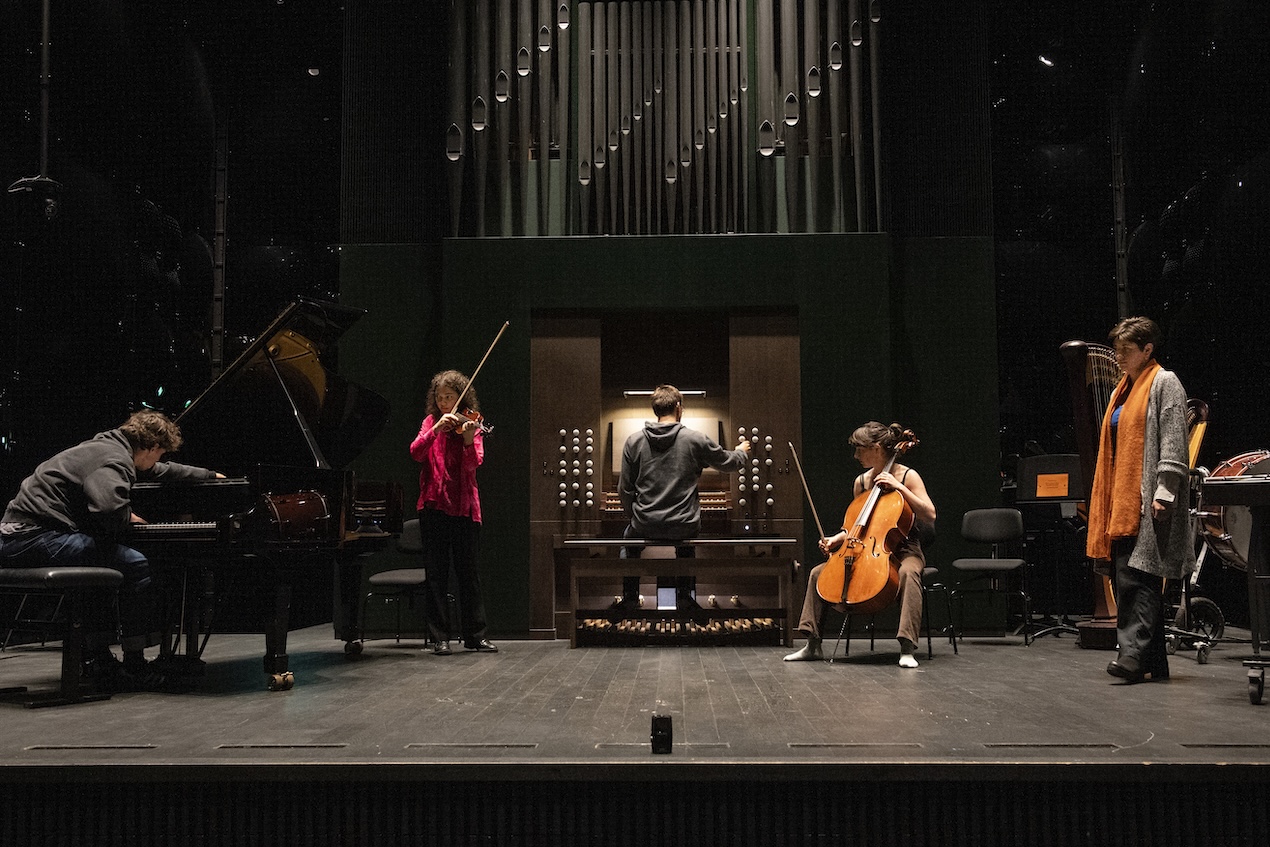
The learning situation thirdly also includes the physical space and the available tools. In Petter’s artistic practice, recording and production are closely connected to improvisation. He often uses DIY techniques and adapts the recording process to the equipment, people and spaces that are available, constantly changing the situation and discovering new methodology. The same curiosity is also something that can be brought into the teaching situation: Students might work in separate rehearsal and studio rooms, move between different acoustic environments or take the work outside the institution. Each setting changes how participants listen and interact. So, the practical limitations of a room or recording setup can become another proposition for making music.
Lastly, but not least, this is about time to reflect. Recording introduces a further mode of listening when the group hears their work played back. Both musicians foster that the students learn to listen back, establishing a more and more fine sense of what they hear and also what they hear while playing. Of course, listening back can become awkward when we judge what we hear. As Petter said in our conversation, he is really trying to establish loving the imperfections, whatever those imperfections are. Listening back reveals aspects of the music that may have gone unnoticed while playing. It also makes audible the distance between what participants intended and what actually happened. Remaining with that distance before correcting or categorising something can allow unexpected qualities to emerge. The group begins to question whether something first heard as a mistake might contain another musical possibility. At this point, collective learning begins to overlap with the necessity of unlearning.
Unlearning
Unlearning, as Petter and Lucas define it, involves questioning the knowledge we bring into a situation and examining the habits and expectations that shape what we hear and how we respond. These may concern musical taste or technique, but also the authority we give to teachers and institutions, or to rules presented as absolute. We, within our institutional role – we as the institution –, need to give the students permission to ask whether what they have learned still serves the art they want to make.
Unlearning happens as we become aware of conventions, we have been following without necessarily choosing them. Introducing propositions that interrupt familiar responses and then paying attention to what follows is one of Petter’s unlearning principles. These interruptions inform his Advanced Metric Modulation workshop, he told us. The workshop has moved away from preparing repertoire for live performance and towards the collective creation and production of tracks. In this process, listening and awareness become guiding principles, as the unfamiliar textures created through post-production and improvised DIY recording techniques encourage experimentation and develops new listening habits.
This principle is also present in Lucas’ exercises, understood as ways of unlearning, rather than ‘improving’ something in a straightforward manner. Lucas describes asking a cello player to breathe like a flute player, or a pianist to play with one finger as if playing a piccolo. The point there is not to imitate another instrument correctly. The proposition temporarily unsettles the relationship between the musician, the instrument and its familiar function. It gives the player a reason to approach the instrument differently. When it comes to free improvisation, it is very important to Lucas that the students step outside their comfort zone, and above all that they are able to recognise and take on a wide variety of roles within an instrumental ensemble. In other words, roles other than those very often found in a chamber music or orchestral context. We don’t always have to wear the same hat. The freedom to take on a different ‘role’ as well.
Unlearning connects with Lucas’ wish that students develop their own artistic language without becoming recognisable copies of their teacher. Our experiences shape what we recognise as valuable, but it can also narrow our attention. A student listening back to an improvisation may hear primarily the distance between their playing and an ideal, a musical style, an idol or role model they are trying to reach. What else becomes audible if we temporarily loosen that comparison?
Listening journals, listening sessions and curiosity
Let´s come back to the practice of listening for a minute and the concept of adding value to something unfinished or, as Petter described it above, adding value to the imperfections. One way to achieve unlearning is through listening together, because by listening we may be able to notice qualities that may initially have been dismissed as imperfections. Examples might include perceived issues with timing or intonation, unintended noises, intended noises not feeling right in the moment, or other things that might fall short of the performer´s expectations. This asks something of the teacher, too.
It requires awareness of our own expectations and how our taste shapes what we encourage. Lucas and Petter share an emphasis on awareness in their respective approaches, both citing Pauline Oliveros as an important influence in shaping this perspective. Oliveros (1932-2016) was an American composer, accordionist, and a pillar of electronic music and exploratory pedagogy. Her Deep Listening practice approaches listening as a form of awareness, experimentation, and collective learning. One practice Petter has recently introduced is the listening journal, adapted from Oliveros (Oliveros 2005: 17).See also Eidenbenz 2024 on these improvisation classes. After a listening exercise, Oliveros asks the listener to describe the experience, give it a title and record the feelings that arose. She also leaves the medium open. Writing can be replaced by another form of recording, allowing a journal entry to be spoken.
Petter has begun keeping a private listening journal as part of his own practice. In teaching, this exercise has grown into a collective listening journal, a shared online document in which observations from the class can accumulate over time. Oliveros writes that “your journal should be private, like your own room.” (ibid.) In the adaptation, he deliberately changes this condition. A private journal can still exist, but the collective journal brings listening observations back into the learning situation. It gives space to experiences that might otherwise disappear and allows one participant’s attention to shape what others notice. Oliveros also writes that, through journaling, experiences can “accumulate meaning” in relation to one another (ibid.). In the collective version, this becomes part of the language the group develops together. The journal records changes in how the group listens, what repeatedly attracts its attention and which sounds or experiences initially pass unnoticed.
Lucas draws on the sense of humor in Oliveros, and alongside playing, a large part of his classes is listening back. He has developed a ritual called Listening Sessions. In the improvisation classes, during the semester every student brings one or two pieces of music of their own choice, and the class analyses them together without knowing who the author is. Surprisingly often, students know not too much about styles beyond their own. Curiosity is the point. Analysing music that students don't know widens their musical vocabulary before they even touch their instruments. And, as a surplus, also the teacher himself has discovered so many great new recordings so far (which is a lovely ‘feedback’).
Creating music
Repertoire can be a valuable source of knowledge and inspiration, but it can also become a hierarchy. Anyway, it will provide a defining structure before the group even begins to work. When repertoire is no longer at the center of the workshop, students and facilitators can enter the process as creators, composers and producers, becoming responsible for deciding together what the music could be. The composition organises our roles, directs our attention and establishes the criteria by which the result will be judged.
- Hochschulbildung (Editorial)
- radical räumlich
- Zukunft: Anregungen für die Forschung in Art Education
- Ausgesetztsein als Dozentin. Vorschlag für eine reflexive Positionierung der Hochschullehre am Beispiel von Kunstpädagogik
- Queer und DIY im Kunstunterricht. Eine Einführung
- Materialien zum Selbststudium
- Editorial Art Education °3
- Performing the Vermittler_in
- Editorial Art Education °2
- Editorial Art Education °1